





Agile Leadership: Enabling Government to Transform for a New Era
Submitted by rgordon on Thu, 06/11/2026 - 10:20
Wednesday, June 10, 2026
Leaders in public sector organizations faces many unique challenges relative to other sectors. Limited financial and personal rewards exist to increase public service motivation or incentivize civil servants. Organizing usually occurs along line-based command-and-control functions, with relatively little freedom to experiment with new work practices—unless officially sanctioned by agency leadership.
At the same time, the current context in which many public agencies operate demands new ways of working. Multi-faceted societal problems cannot simply be solved by leveraging a single expertise. Instead, they require the involvement of diverse competencies that typically span multiple agencies. They require teams with cross-functional competencies to work together. Examples of these cross-domain problems include mobility issues, digital transformation of complex processes, enterprise data management tasks, and many more.
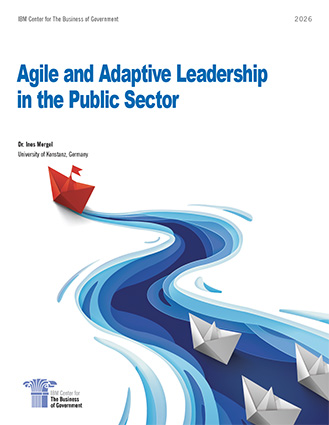
In this context, few questions in public management have grown more consequential in recent years than this: how can leaders take positive actions when conditions keep changing? As shown in a new report from the IBM Center -- Agile and Adaptive Leadership in the Public Sector, by Dr. Ines Mergel, Professor of Public Administration at the University of Konstanz, Germany – leaders face the daily reality of managing agencies through demands that emerged from the pandemic era, digital transformation, and geopolitical disruption. Traditional command-and-control hierarchies were built for a different world. This report addresses leadership in the world today.
Professor Mergel brings scholarly depth and practical orientation to the topic. Drawing on extensive research in public administration and organizational behavior, she reframes agile as much more than a project management methodology borrowed from software development—rather, the agile paradigm represents a fundamentally different way of thinking about leadership. Many government efforts to adopt agile have focused on the mechanics of scrums and sprints while leaving untouched the deeper implications for leadership, which the report focuses on.
The report opens with an examination of why agile approaches have become so urgent for public sector organizations, and what this change demands of the government workforce. To address increasing complexity, governments have started to develop flexible project-based strategies and processes that allow for time-bound cross-functional collaboration. This parallel project-based approach can challenge leadership and organizational norms in the public sector, rewarding time and effort for regular work as well as the extraordinary work done in the parallel project.
From there, the author explores agile leadership across several interconnected dimensions: the mindset required to lead in an adaptive fashion, the specific work practices that make agile teams function effectively, and the organizational conditions that either support or undermine those teams.
Professor Mergel treats agile leadership as emanating from self-leadership, contending that leaders cannot create conditions for adaptive teams if they remain wedded to fixed thinking. Her discussion of growth versus fixed mindsets, and of promotion-focused versus prevention-focused orientations, gives leaders a framework for candid self-assessment.
The report's attention to the need for flexibility also deserves notice. Iterative learning, adjustments based on empirical data, and the willingness to surface failure and make changes early all require an environment that supports speaking up about problems to correct. These elements provide a structural precondition for agile work to function.
Indeed, leading agile teams in the digital age has become a central skill for public managers, who need to understand their teams’ capabilities and how best to provide support and guidance to them. The recommendations in this report – which add to a growing body of research on agile government, including studies from the IBM Center directly and in collaboration with the Agile Government Center of the National Academy of Public Administration -- inform government leaders of different dimensions of successful agile leadership, as well as ways to apply these dimensions directly in their daily work.
We hope this report will offer value to a broad audience, including senior executives working through the realities of organizational transformation, mid-level managers building cross-functional teams under resource constraints, and those responsible for developing the next generation of public sector leaders.