





Building Resilient Federal Supply Chains: Advancing Visibility, Efficiency, and Modernization
Submitted by rgordon on Wed, 03/11/2026 - 15:21
Wednesday, March 11, 2026
Blog Co-Author: Camille Johnson, Senior Consultant, Talent Transformation, IBM
Over the past few years, supply chain management has surged in national importance as federal systems confront mounting geopolitical uncertainty, rapid technological disruption, and growing demands for transparency and performance. Against this backdrop, the IBM Center for The Business of Government convened the Building Resilient Federal Supply Chains: Advancing Visibility, Efficiency and Modernization roundtable on February 5, 2026, bringing together leaders from government, industry, and the global community to examine how federal supply chains can be modernized to withstand continuous and unpredictable shocks.
Despite rapid technological advances, the foundational principles of effective supply chain management remain largely unchanged, keynote speaker Dr. Zal Phiroz, Associate Professor, Supply Chain and Data Analytics, Harvard University, noted. Drawing on experiences with the private sector and academic research, Dr. Phiroz emphasized the shift from cost-centric performance to factors around resilience, agility, regulatory awareness, and adaptability —even as AI, driverless technologies, and 3D printing reshape the landscape. Dr. Phiroz added that both public and private sectors face tension between enthusiasm to embrace the efficiency, quality, and productivity gains offered by AI and concerns about data relevance, governance, and trust.
Data Precision
Should AI be held to higher standard than those applied to human analysis? Several participants considered this question as many federal processes, including forecasting and procurement, remain deeply manual. Imperfect data is the norm. Federal supply chains must consider whether AI improves outcomes relative to existing methods rather than achieving perfection. Participants agreed that tracking too many data indicators can dilute focus; instead, agencies should determine what truly matters, align metrics to mission needs, and recognize that different problems require different solutions.
While there wsa agreement on this in principle, there was also recognition of a critical need for precision in industries such as healthcare – an industry where incorrect forecasting can result in errors that have potentially costly impacts. For example, in Zambia, where the Zambia Medicines and Medical Supplies Agency (ZAMMSA) operates one of Africa’s most complex supply chains, the agency still struggles to accurately predict demand. Contrasted with Coca‑Cola’s ability to reach remote regions, while essential medicines often do not—is a challenge documented in a Center study Emulating Value Chains of Consumer Goods to Save Lives: A Case Study of ColaLife’s Work in Zambia. Participants agreed that without visibility into the multitude of factors that impact supply chains—and the human realities that shape them—AI-driven data insights alone cannot prevent disruptions.
Supply Chains as Networks
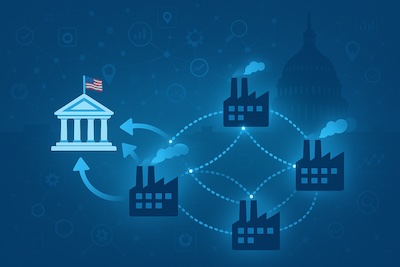
Throughout the discussion, participants stressed that supply chains must be understood not as linear pipelines but as interconnected networks. As an example, Puerto Rico, Japan, and the E.U. are restructuring supply networks in response to geopolitical disruptions and reliance on single suppliers, with geography and policy playing major roles in shaping the pace of change. In the U.S., legal and regulatory constraints—such as the Trade Secrets Act—continue to limit the data sharing necessary for full visibility into supply chain vulnerabilities.
Participants discussed the concept of shifting the dialogue with supply chain ecosystem partners from data as an input to data across a network -- the idea that shared visibility and accountability are required across the ecosystem to appropriately assess risk and resilience, especially related to supply chains that impact national security. The traditional tiered structure of supply chains reduces visibility into lower‑tier suppliers, whose vulnerabilities can undermine entire systems when data is scarce or unreliable. Diversification on higher levels of a supply chain can be thwarted by a lack of diversity or even no diversity in lower-level suppliers. Shifting the ecosystem mindset to a more collective view of risk and resillience would require changes to current operating models and data sharing agreements.
Conclusion
Together, participants underscored that a resilient federal supply chain requires understanding the full network—suppliers, sub‑suppliers, and the information that links them—is essential for transparency, diversification, and preventing disruptions across the federal supply chain.
The IBM Center will soon release a report from Professor Phiroz with a more detailed set of findings and recommendations from the Roudntable.