





From Promise to Delivery: Dr. Paul Lawrence on the Mission of Serving Veterans
Submitted by MKeegan on Fri, 04/24/2026 - 11:21
Wednesday, April 22, 2026
Not many government leaders return to an institution carrying the same sense of mission and unfinished business as Dr. Paul R. Lawrence. Recently, I spoke with him on The Business of Government Hour in his current role as Deputy Secretary of the U.S. Department of Veterans Affairs. A role he had accepted, by his own telling, because the pull of what remained undone was simply too strong to ignore.
We talked about leadership, but not in the way these conversations usually go. Vision, innovation, transformation — those words came up. Yet what emerged most clearly from our exchange was something more grounded. At scale, leadership is fundamentally about delivery: the day-to-day reality of whether an organization does what it promises, consistently, reliably, and at the level of quality its mission demands.
When I asked what brought him back to VA, Dr. Lawrence didn't hesitate.
"I thought the chance to come back and finish things that we left undone that we wanted to do, and to make things better for veterans, was really too great an opportunity to miss."
His return came with a considerably expanded portfolio. As Deputy Secretary, Dr. Lawrence oversees the daily operations of a department that employs more than 441,000 people, runs the largest hospital network in the country, and delivers over $100 billion in benefits every year. The role demands both strategic vision and granular operational command. He brings both.
This essay draws on our conversation — a look at what it takes to lead one of the largest service organizations in the federal government, where mission is not a talking point but a daily obligation, and where leadership is measured not in words but in the people it serves.
Strategic Vision and Core Priorities
The organizing principle animating VA under this leadership team is deceptively simple: put veterans at the center of everything. Secretary Doug Collins made it the department's North Star. Dr. Lawrence gives that principle operational meaning.
"Our strategic vision for the department is to provide veterans with world-class healthcare benefits and memorial services. That is our mission, and that's what we want to do. We use world-class because we really want the experience with us to be excellent. Maybe we never attain that, but we're going to keep trying, and that's part of the point."
"World-class" appears in a lot of government strategy documents. It signals aspiration. Too often, it stops there. What stood out in talking with Dr. Lawrence is how deliberately he pushes past the phrase — how he translates intent into metrics. The department tracks veteran access to care, claims timeliness, and customer satisfaction scores across all three major service arms: the Veterans Health Administration (VHA), the Veterans Benefits Administration (VBA), and the National Cemetery Administration (NCA). The NCA, he noted with evident pride, consistently tops the American Customer Satisfaction Index regardless of sector. That's a rare distinction in any organization, public or private.
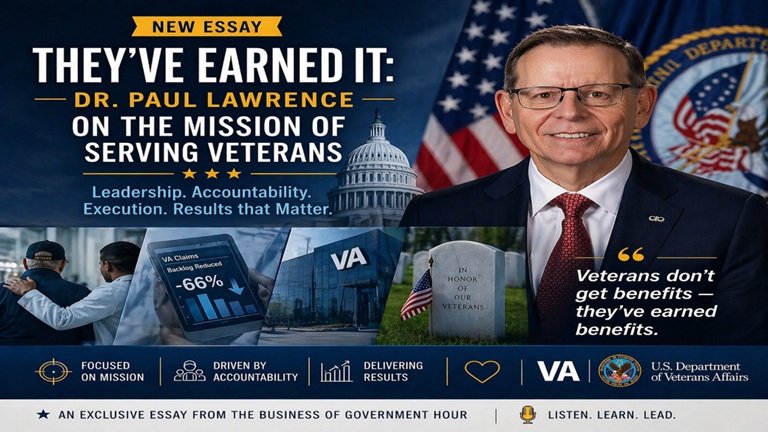
Perhaps the most striking operational achievement he cited was the dramatic reduction in the claims backlog. When the current administration took office, more than 265,000 veterans were waiting over 125 days to have their claims processed — an average that stretched to 140 days.
"Right now, the backlog is at 87,000, which means we have reduced it by two-thirds. And so it is possible — and we did that with, quite frankly, fewer employees than the year before. We are doing more with less."
That reduction didn't happen by accident. It came through better management, sharper goal alignment, and a relentless focus on veteran feedback. At this scale, serving millions of people requires the same discipline you'd expect in any high-performing enterprise: clear standards, measurable outcomes, and feedback loops that actually drive action.1
The Risk of Policy Without Implementation
If the backlog story shows what disciplined execution can achieve, the story of the PACT Act reveals what happens when execution is treated as an afterthought. Dr. Lawrence didn't soften his critique. The legislation was significant — it expanded benefits and addressed long-standing needs. But passing a law, he noted plainly, is only the beginning.
"You can't just award benefits. You have to think about how to administer them."
That gap between policy design and operational readiness produced predictable results. Claims surged; the backlog climbed above 400,000; the system strained under the weight of new demand. And beyond the numbers, something harder to quantify was at stake.
"When you make a promise… and don't think through delivery, you breed distrust."
This pattern isn't unique to VA. It recurs across government, in programs large and small. The lesson is neither new nor complicated but it remains chronically underappreciated. Policy and operations are inseparable. Designing one without the other isn't just inefficient; it erodes trust.
Modernization at Scale: Getting the EHR Right
Few initiatives capture the complexity of government transformation quite like the VA's Electronic Health Record modernization. One of the largest IT undertakings in federal history, the project had been stalled. Dr. Lawrence was candid about that troubled past and equally candid about what's required to get it right.
The fix, in his view, rests on three things: intentional leadership, standardization, and organizational alignment. In practice, that means treating the program as a genuine top priority, eliminating years of accumulated customization that had fragmented the system into incompatible configurations, and committing to a defined deployment schedule — 13 sites in 2026, 26 in 2027, and 28 to 30 per year until full deployment across all VA facilities by 2031.
His phrase says it all: "One VA will be one VA."
That shift from fragmentation to standardization isn't purely a technology problem. It's cultural, and it's about governance. It's also where most large-scale IT efforts in government stumble.
Addressing Homelessness, Suicide, and the Most Vulnerable Veterans
Two of the most persistently difficult challenges in veteran welfare — homelessness and suicide — also came up in our conversation. Both areas have absorbed significant investment over the years. Progress, when it's come, has been hard-won.
On suicide prevention, Dr. Lawrence described a willingness to step back and ask uncomfortable questions about whether current approaches are actually working, and if not, what needs to change.
"What are we doing with all this money… aren't there better ways?"
There's humility in that question but resolve too. The department has been scrubbing grant programs for evidence of impact, installing new leadership in the suicide prevention office, and actively pursuing alternative frameworks.
"The desire to try new approaches and look to new sources for insight and advice is something that is really dominating our thinking right now."
On homelessness, the news was more concrete. In a single year, VA housed nearly 52,000 homeless veterans — more than in the previous seven years combined. The strategy involves aggressive interagency collaboration, particularly with HUD, and genuine engagement with nonprofits pushing hard to move the needle alongside the department.
No single intervention solves this problem. No single organization owns it. That's where leadership expands beyond organizational boundaries into something more demanding: systems thinking, partnership, and shared accountability.
Organizational Reform and Workforce Accountability
While pursuing these mission-critical priorities, VA is also in the middle of one of the most significant structural reorganizations in its history. The department is streamlining the Veterans Health Administration by removing layers of middle management — reform that GAO, the Inspector General, Congress, and the National Academy of Public Administration have all called for. That it's happening now, Dr. Lawrence acknowledged, is a historic development.
He captured the goal in a phrase that's vivid and precise: "Less tail, more tooth."
It's a reorientation toward where value is actually created — a signal that the department is shifting from managing structure to delivering outcomes.
Alongside structural reform, Dr. Lawrence is confronting a deeply embedded cultural problem: grade inflation in performance evaluations. At its worst, 94% of VA employees received the highest possible rating on the government's five-point evaluation scale.
"That's sinful, okay, and certainly can't be true. We dishonor everyone when we don't deal with poor performers."
When everyone is rated the same, performance loses meaning. Accountability erodes. Excellence becomes indistinguishable from adequacy. VA's response has been to reintroduce real differentiation — linking performance to rewards, addressing underperformance directly, and holding the line on standards that reflect genuine expectations.
At the same time, the department is investing in its workforce, recognizing that its scale and its mission depend entirely on the people who carry it out. The message to VA's 441,000 employees is one of clarity and respect: the department values those who are excellent and mission-focused, recruits aggressively for talent, and won't tolerate indifference to the work. This is a culture-change agenda, and it lives in HR systems and daily management behavior, not in posters on a wall.
Artificial Intelligence: Promise, Guardrails, and the Human Element
At a time when AI dominates nearly every conversation about institutional transformation, Dr. Lawrence's perspective was notably measured. VA is deploying artificial intelligence in focused, human-supervised ways: ambient transcription tools that free clinicians from manual notetaking, and AI-assisted claims assembly that gathers and organizes information while leaving final decisions to human adjudicators.
The balance he articulates is straightforward — use technology to reduce the rote and repetitive, while preserving human judgment where it matters most. In a system built on trust, care, and accountability, that boundary is essential.
"We want to be able to make sure we deliver personalized care. We don't want our employees to do rote mindless work that technology can do for them. But we also understand there's a significant human element to the services we provide, and that's never going to be replaced."
The line he draws is clear: "People still make decisions."
Leadership Lessons: Articulate, Communicate, Measure
If there's a single thread running through Dr. Lawrence's approach to leadership, it's this: transformation is less about breakthrough moments and more about sustained discipline. The VA's progress on the claims backlog makes that point more concrete than any abstract argument could.
One of the most useful passages in our conversation was his articulation of the management framework he's carried across two tenures at VA. It's elegant in its simplicity.
"Articulate, communicate, and measure. These three actions, regardless of where I find myself, are integral to [effective leadership]. Part of the problem is we often measure and monitor to penalize people. Could be they don't understand. They're not certain what's expected of them."
This framework grew from experience. On his first day as Under Secretary for Benefits, Dr. Lawrence walked through headquarters introducing himself only to be met by employees who had no idea who he was. That encounter made something concrete: in large organizations, the gap between leadership visibility and organizational understanding is real, and it costs you.
Transformation rarely arrives as a dramatic breakthrough. More often, it's the cumulative result of getting the right things right — consistently, over time.
The Road Ahead
Looking ahead, Dr. Lawrence laid out a clear and ambitious agenda. The foundational work of 2025 — reducing the claims backlog, restarting the EHR, reforming VHA — is giving way to a delivery phase in which those investments will show up in veterans' lives in tangible ways: faster care, more coordinated community options, a modern digital health record, and a leaner, more responsive organizational structure.
But beneath all of it is a simpler goal.
"Quick, fast, and in a hurry," as he put it.
And then the line that reframes everything:
"Veterans don't get benefits — they've earned benefits."
That distinction matters. It shifts the relationship from service delivery to obligation fulfilled.
Near the end of our conversation, Dr. Lawrence returned to VA's founding charge — Lincoln's words, inscribed in the department's mission: to care for those who have borne the battle. Seventeen million veterans are alive in the U.S today. Nine million access VA healthcare. His final message was a direct appeal to the rest.
"We encourage all veterans to connect with the VA because we think it's a great community — and it's a community they've earned the right to belong to."
It's rare to interview a senior government leader who carries both the operational command of a COO and the moral clarity of a mission-driven servant.
Dr. Paul Lawrence is that kind of leader. His return to VA reflects something true about the best of public service: that the work is never simply a job, but a calling — and that when important work remains undone, the right leader comes back to finish it.